

How to Increase Diesel Horsepower Safely: A Step-by-Step Guide
Last Updated: November 8, 2026
Quick Summary
To increase diesel horsepower safely, add power in stages, starting with a reversible plug-in performance module that leaves no ECM footprint, then measure each change with a monitor. Only add hardware like intake, exhaust, injectors, or turbo when logged EGT, boost, coolant, and transmission temperatures stay within your tuner's limits.
- A plug-in module improves throttle response and reduces turbo lag without flashing the factory ECM calibration.
- Log EGT, boost pressure, coolant temperature, and transmission temperature instead of relying on a glance gauge.
- Removing or defeating emissions equipment on a street-driven vehicle violates the Clean Air Act.
- The 6.7L Cummins 68RFE automatic transmission is a common weak link once torque climbs past stock.
- Stop adding parts when a monitored channel exceeds the range your tuner or manufacturer specifies.
Table of Contents
- Why Safe Diesel Horsepower Gains Start With a Plan
- The Safest First Step: Diesel Performance Tuning Without an ECM Footprint
- Diesel Engine Performance Upgrades That Support More Power
- Turbocharger Upgrades and Boost Pressure: When a Larger Turbo Makes Sense
- Fuel Injectors and Fuel Delivery: Matching Fuel to Air
- Diesel Engine Reliability Upgrades: Monitoring, Cooling, and Drivetrain Capacity
- Diesel Emissions System Modifications and Legal Compliance
- A Staged Upgrade Plan for Cummins, Duramax, and Power Stroke Owners
- Choose Your First Safe Diesel Horsepower Upgrade
- Frequently Asked Questions
Why Safe Diesel Horsepower Gains Start With a Plan
Learning how to increase diesel horsepower safely starts with a simple principle: add power in stages, measure each change, and never exceed what the stock engine and drivetrain can support. Owners who chase big dyno numbers can lose a transmission or a turbo months later. The problem is rarely the parts. It is the order they go in.
A diesel engine makes power by balancing three things: air, fuel, and the timing that brings them together. Push any one of those beyond what the others can support and you get heat, stress, and premature wear. That is the whole story behind most failed builds.
Here is the part most guides skip. Safe power gains are not about the biggest single modification. They are about stacking small, reversible changes that keep the air-to-fuel ratio and exhaust gas temperature inside safe limits.
That is why we built our approach around diesel performance tuning that works with stock settings instead of rewriting them. Our modules leave no ECM footprint, so the factory calibration stays intact. Below, we will walk through each upgrade in the order we would do it, what it costs you in reliability, and how to know when to stop.
The Safest First Step: Diesel Performance Tuning Without an ECM Footprint
The safest first upgrade is a plug-in performance module that improves throttle response and reduces turbo lag without flashing or altering the factory ECM calibration. It is reversible in minutes, adds no diagnostic footprint, and lets you feel the change before you spend on hardware.
Diesel performance tuning comes in two flavors. One rewrites the ECM calibration. The other works through the existing sensor signals.
For a stock truck under warranty, that distinction matters more than the peak number on a dyno sheet.
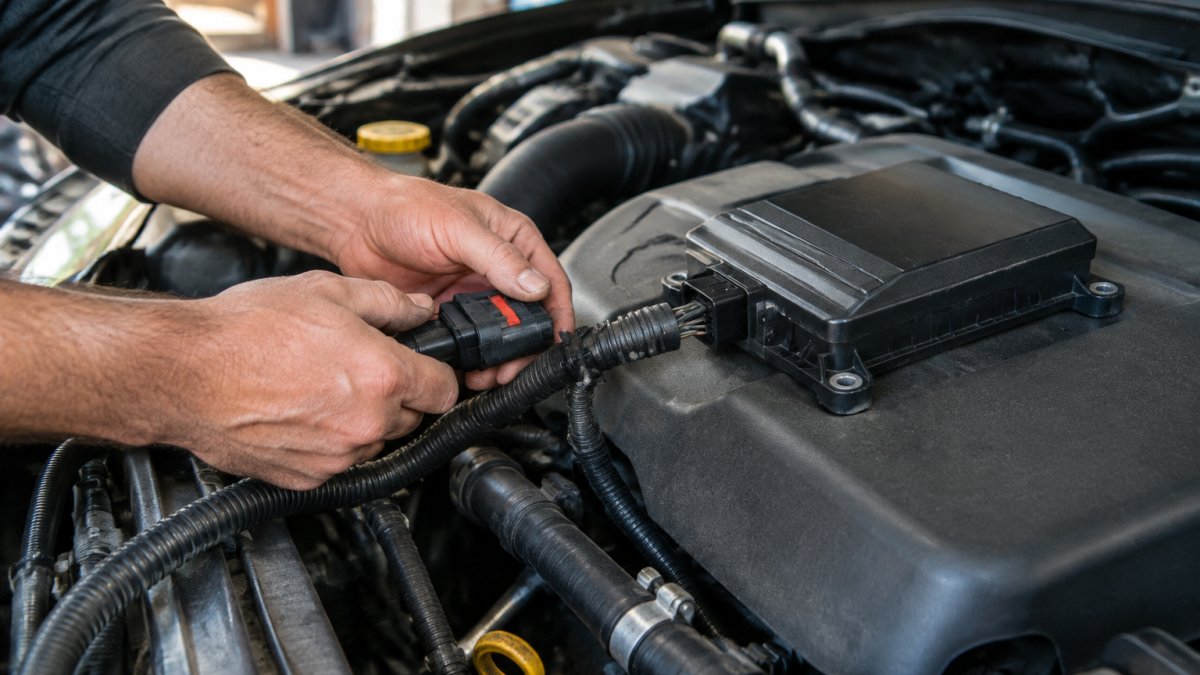
Our modules use Combustion-Efficient Technology to improve driving-zone power, with no need to modify your intake, turbo, or exhaust and no gauges to install. They fit Cummins, Duramax, and Power Stroke engines and install under the hood with OEM-style connectors. If you want to understand the trade-offs before choosing, our buyer's guide to performance chip alternatives compares the options, and our article on whether diesel performance modules are worth it covers the economics.
Diesel Engine Performance Upgrades That Support More Power
Hardware upgrades support more power by improving airflow in and exhaust out, which lets the engine burn fuel more completely. The catch is that each one changes the balance of air, fuel, and heat, so they only help when matched to the tuning and the load you actually run.
Air Intake and Airflow Improvements
A cold air intake reduces restriction on the inlet side and supports added power when paired with tuning. It is one of the few diesel engine performance upgrades that helps response without touching fuel delivery.
For a 2020-2026 6.6L Duramax, our cold air intake systems are designed to pair with a module. If you want the specific fitment, the Momentum HD cold air intake with Pro Dry S filter is dyno-tuned with a one-piece XLPE housing and a three-layer Pro Dry S filter, listed at $453.00.

Exhaust Flow and Backpressure
Exhaust upgrades reduce backpressure, which lowers exhaust gas temperature and helps the turbo breathe. On a stock truck, the downpipe and the emissions equipment are usually the biggest restrictions.
Be careful here. Removing emissions hardware is a legal question, not just a performance one, and we cover that below. A cat-back system or a better-flowing muffler gives some benefit with no compliance risk.
Turbocharger Upgrades and Boost Pressure: When a Larger Turbo Makes Sense
A larger turbo makes sense when you have maxed out the stock unit and can support the extra boost pressure with fuel and cooling. For most tow rigs, it is the last upgrade, not the first.
Turbocharger swaps raise the ceiling on airflow, but they trade low-end response for top-end power. A bigger compressor wheel takes longer to spool, which is exactly the wrong trade for a truck pulling a 12,000 lb fifth wheel up a grade.
Boost pressure also raises cylinder pressure and heat. Without a cooling system upgrade and a way to watch exhaust gas temperature, you are guessing. Watch out: turning up boost on a stock turbo past its efficiency map adds heat without adding much usable power.
Fuel Injectors and Fuel Delivery: Matching Fuel to Air
Fuel injectors and the rest of the fuel system set the ceiling on how much power the engine can make. Bigger injectors deliver more diesel fuel, but only help if the turbo can supply the air to burn it.
Matching injector size to your airflow is the whole game. Oversized injectors on a stock turbo dump unburned fuel, raise exhaust gas temperature, and hurt fuel consumption. Undersized injectors starve a bigger turbo.
Diesel Engine Reliability Upgrades: Monitoring, Cooling, and Drivetrain Capacity
Diesel engine reliability upgrades protect the gains you have already made. Monitoring, cooling, and drivetrain capacity are what separate a build that lasts from one that fails on the first long pull. This is the section most power guides skip, and it is where a staged plan either holds together or falls apart.
What to Monitor and Why
Start with a monitor that can log, not just display. A gauge you glance at on a grade tells you less than a log you can review afterward. The four channels that matter most are exhaust gas temperature (EGT), boost pressure, coolant temperature, and transmission temperature.
EGT is the single best proxy for how hard the engine is working. Most practitioners find that sustained EGT should stay well inside the limit your engine builder or tuner specifies, and that pre-turbo EGT reads hotter than post-turbo. Know which location your probe uses before comparing numbers to anyone else's.
Boost pressure tells you whether the turbo is operating inside its efficiency map. Boost that climbs without a matching drop in EGT usually means the turbo is adding heat rather than usable airflow.
Coolant temperature and transmission temperature are the early-warning channels. A coolant temperature that creeps up on a long grade, or a transmission temperature that climbs past the normal range, is telling you the supporting system is at its limit before the engine is.
Cooling System Capacity
The radiator, intercooler, and transmission cooler all carry more heat once you add power. On a stock truck, the intercooler is often the first part to become a restriction after a tune, because it was sized for stock boost. A larger intercooler lowers intake air temperature, which in turn lowers EGT and lets the engine make the same power with less heat stress. The transmission cooler deserves equal attention, especially on trucks that tow. Keeping the cooling system and transmission in good condition helps protect those gains over time, a priority shared by Inland Auto and Truck.
Drivetrain Capacity
A stock transmission calibrated for stock torque is often the first thing to fail after a big gain. The failure mode is usually heat and clutch-pack wear rather than a sudden break, which is why transmission temperature logging matters. On manual trucks, the clutch is the equivalent weak link. Braking capacity also deserves a look: more power means you arrive at the bottom of a grade faster, and stock brakes sized for stock power may not be adequate for a loaded trailer.
When to Stop
The honest answer is that you stop when a monitored channel tells you to. If EGT, coolant temperature, or transmission temperature climbs past the range your tuner or manufacturer specifies on a sustained loaded pull, you have found the limit of the current stage. Adding the next part without addressing that channel is how builds fail.
That is why we favor modest, driving-zone gains over peak numbers. Our modules are designed to work with stock engines and powertrains, never deleting or modifying stock settings, which keeps the stress on supporting parts predictable.
Diesel Emissions System Modifications and Legal Compliance
Diesel emissions system modifications are where safe power gains get complicated. Under federal law, tampering with emissions controls on a street-driven vehicle is illegal, and several states run their own inspection programs on top of that.
The U.S. Environmental Protection Agency's guidance on vehicle tampering is clear that removing or defeating emissions equipment on a certified highway vehicle violates the Clean Air Act. That includes delete tunes and DPF removals, regardless of how the truck is used.
This is the angle most power guides skip entirely. A modification that adds horsepower but fails an inspection or voids your registration is not a safe upgrade, it is a liability. Before you buy anything that touches the exhaust or the emissions hardware, check your state's inspection rules and your warranty terms.
Our modules are designed to work with stock engines and powertrains, never deleting or modifying stock settings.
A Staged Upgrade Plan for Cummins, Duramax, and Power Stroke Owners
A staged plan lets you add power, measure the result, and stop before reliability suffers. The table below is the order most practitioners recommend, but the real safety work happens in the engine-specific limits that follow it.
| Stage | Upgrade | What It Delivers | Main Trade-off | Validate Before Moving On |
|---|---|---|---|---|
| 1 | Plug-in performance module | Better throttle response, reduced turbo lag, driving-zone torque | Modest peak gains only | Log boost and EGT on a long grade; confirm no derate or check-engine light |
| 2 | Cold air intake | Faster spool, supports stage 1 | Little gain on its own | Confirm intake air temperature drops and no water-ingestion risk |
| 3 | Exhaust and monitoring | Lower backpressure, visible EGT thresholds | Compliance check required | Verify EGT stays inside your tuner's limit on a sustained pull |
| 4 | Injectors and fuel delivery | More headroom for airflow | Needs matched turbo | Check rail pressure holds and injector balance rates stay in spec |
| 5 | Turbo and cooling | Higher airflow ceiling | Costly, laggy at low RPM | Monitor boost, EGT, and coolant temperature together on a loaded grade |
Engine-Specific Limits and Compatibility
The table is only a skeleton. What actually keeps a build safe is knowing where each engine family runs out of headroom first.
6.7L Cummins (Ram 2500/3500). The engine block and head are robust, but the 68RFE automatic transmission is the common weak link once torque climbs well past stock. Many owners find the transmission cooler and valve body are the first supporting parts to address. The 6.7L also uses a variable-geometry turbo whose actuator and vanes are sensitive to soot; a tune that commands aggressive boost without addressing EGR fouling can shorten turbo life. Verify which emissions hardware your model year carries before buying exhaust parts.
6.6L Duramax L5P (2017+). The L5P uses a denser emissions package and a different fuel system than earlier Duramax generations, so parts that fit an LML or LMM often do not fit an L5P. The Allison transmission is generally stronger than the Cummins' 68RFE, but the torque converter and cooler still deserve attention on tuned trucks. Confirm fitment by model year and engine code, not just by "Duramax."
6.7L Power Stroke (2011+). The 6.7L Power Stroke uses a reverse-flow cooling system and a compact turbo layout, which makes some turbo and exhaust upgrades more involved than on the Cummins. The 6R140 transmission is capable but has its own torque limits, and the emissions hardware varies by model year. Verify the specific calibration and hardware for your year before ordering.
Across all three, the pattern is the same: the engine itself usually has more headroom than the transmission, cooling system, or emissions hardware bolted to it. A common mistake is buying parts by engine family name without checking the model year, engine code, and transmission pairing.
Watch out: a part listed as fitting "Cummins" or "Duramax" may not fit your specific year and engine code, and returning a mis-fit turbo or injector set is expensive.
For most stock trucks, stage 1 delivers the change owners actually feel. The 6.7L Cummins Ram module for 2019-2024 and the 6.6L Duramax L5P module for 2024-2026 are both listed at $695.00, and the 6.7L Power Stroke module for 2020-2026 is $625.00. Each is a do-it-yourself install with OEM-style harnesses. Duramax owners planning their build can start with our guide to the best performance chip for Duramax.
Choose Your First Safe Diesel Horsepower Upgrade
The fastest way to add diesel horsepower without risking your powertrain is to start with a reversible, no-footprint module, measure the change, and only then consider hardware. Most owners never need to go past that first stage to get the towing response they wanted.
We have been building these modules since 2003, they are USA-made, and they carry a 3-year warranty with a moneyback guarantee. One Cummins commuter reported a more responsive throttle and faster turbo spool-up, with an average gain of 3 mpg after two months. Another owner towing a dump trailer reported the truck moves when needed, with no increased EGTs.
If you are ready to feel the difference on your own truck, start with the module matched to your engine.
Adding power to a diesel does not have to mean gambling with your warranty or your transmission. The right first step is the one you can undo, measure, and build on. Diesel Modules gives you a warranty-friendly module with no ECM footprint, do-it-yourself installation, and USA-made engineering that works with your stock settings. Get started with Diesel Modules and add usable torque without rewriting your factory calibration.
Frequently Asked Questions
What is the safest way to add diesel horsepower?
Start with a plug-and-play module that works with stock ECM settings rather than a flash tune that overwrites them. A module like the 6.7L Cummins Ram (2019-2024) #60261 at $695 adds driving-zone power and reduces turbo lag without leaving a footprint on the ECM. Pair it with a cold air intake for airflow.
Can a diesel tuner damage the engine or transmission?
Yes, if it pushes fuel and boost beyond what the stock internals and transmission can handle. Aggressive tuning raises cylinder pressure and exhaust gas temperature, and the extra torque can exceed the transmission's rated capacity, especially on trucks that tow heavy trailers.
How much horsepower can a stock diesel engine safely handle?
It varies by engine and drivetrain, so check your specific model's rated torque capacity rather than relying on a generic number. The 6.6L Duramax L5P (2017-2023) #61700 at $695 and the 6.7L Power Stroke (2020-2026) #62400 at $625 are designed for stock engines and powertrains.
Is it legal to remove or disable a diesel DEF system?
No. Under the Clean Air Act, tampering with or removing emissions control equipment, including the diesel exhaust fluid system, is illegal for on-road vehicles. Safe diesel horsepower gains come from tuning and airflow improvements that keep the emissions system intact, not from deleting it. Always verify compliance with your state's inspection rules before any modification.
Which diesel performance upgrades should you do first?
Begin with a warranty-friendly module, then add a cold air intake such as the Cold Air Intake Momentum HD w/Pro Dry S Filter 50-70056d at $453 for 2020-2026 6.6L Duramax. These two deliver better throttle response and reduced turbo lag without touching the ECM or exhaust. Add monitoring gauges before fuel injector or turbocharger changes.
How can you improve diesel performance without reducing reliability?
Use a module that works with stock settings, like the 6.6L Duramax L5P (2024-2026) #61720 at $695, which improves fuel economy by up to 20 percent and reduces turbo lag without deleting or modifying stock parameters. Regular maintenance, clean fuel, and a cooling system in good condition protect reliability as power increases.
Prices of diesel performance modules and intake
