

How to Fix Diesel Turbo Lag: 4 Diagnostic Steps
Quick Summary
Diesel turbo lag is the short delay before boost arrives after you press the throttle, because the turbo needs exhaust flow to spin up. To fix it, first rule out boost leaks, clogged filters, and actuator faults, since these can mimic normal lag. Only after those checks should you consider an upgrade.
- Slow response from idle is normal on a cold, lightly loaded engine.
- Delay that worsens over time or leaves the truck flat under load signals a fault.
- Check cracked charge pipes, loose clamps, and worn intake boots for boost leaks.
- Compare requested and actual boost during a steady throttle press to spot a leak.
- Log actuator command and position feedback to find a stuck vane or faulty sensor.
Table of Contents
- What Causes Turbo Lag in Diesel Engines and How to Tell It Apart From a Fault
- Checking for Diesel Boost Leak Symptoms
- Diagnosing Diesel Turbo Actuator Problems
- Choosing a Diesel Throttle Response Upgrade After Your Checks
- Frequently Asked Questions
What Causes Turbo Lag in Diesel Engines and How to Tell It Apart From a Fault
Diesel turbo lag is the short delay between pressing the throttle and feeling boost arrive, since the turbo needs exhaust flow to spin up. A cold, lightly loaded engine often responds slowly, which is normal; a fault is delay that worsens over time or leaves the truck flat under load.
Watch out: a worn or stuck actuator can mimic normal lag, so don't rule out a fault just because the truck feels sluggish from a stop.
Compare where boost begins against your service manual (thresholds vary by engine and load), then check requested versus actual boost on your scan tool.
- Normal lag: slow response from idle, smooth and consistent once boost builds
- Likely fault: delay that worsens week over week, boost that never reaches the requested level, or new diagnostic trouble codes
Checking for Diesel Boost Leak Symptoms
Boost leaks are a common cause of diesel turbo lag that looks like a turbo problem. Air escaping through a cracked charge pipe, loose clamp, split hose, or worn intake boot means the engine never gets the air it was metered, causing slow pull, a falling boost gauge under load, and sometimes smoky exhaust.
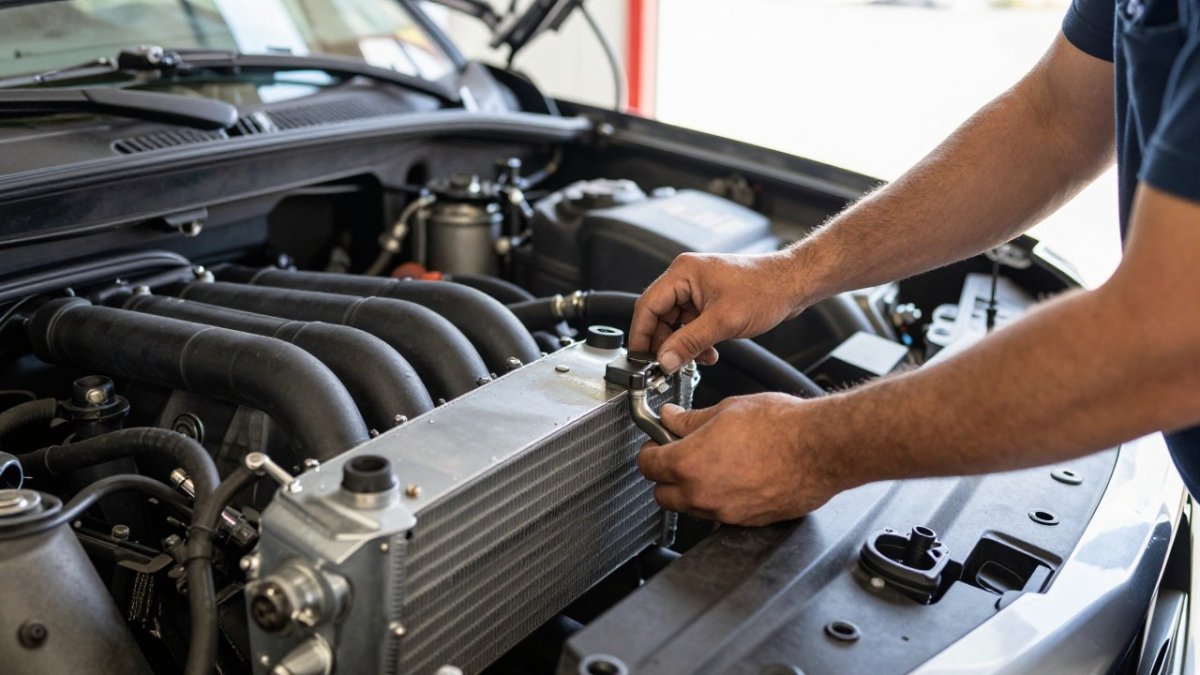
With the engine off, inspect every charge pipe and hose from turbo outlet to intake manifold for cracks, wet or oily residue at clamps, and black soot streaks. Gently twist each pipe; any movement at a joint means the clamp or coupling needs attention.
At steady idle, listen along the intake path for hissing or whistling. A low-pressure smoke tester locates leaks most reliably. Keep hands clear of pressurized openings.
To confirm, compare requested and actual boost during a steady throttle press. A large, repeatable gap with the turbo spinning normally points to a leak downstream of the turbo; leaks appearing only under load often sit at couplings that open as the pipe flexes.
Watch out: a leak on the hot side of the intercooler can release hot, pressurized air, so let the engine cool before disconnecting anything.
A split pipe or failed coupling is usually a low-cost, low-skill fix. If the leak traces to the turbo seal or intercooler core, or clamps keep loosening, have a diesel technician pressure-test the full intake path first.
Boost leaks are a common cause of lag that looks like a turbo fault, and the main symptoms and fixes are summarised below.
| Symptom | Likely cause | Fix |
|---|---|---|
| Slow pull under load | Air escaping before the engine | Repair leak at pipe or clamp |
| Falling boost gauge under load | Crack in charge pipe or hose | Replace split pipe or hose |
| Hissing or whistling at idle | Loose clamp or coupling | Tighten or replace clamp |
| Smoky exhaust | Boost leak in intake path | Pressure-test full intake path |
| Gap between requested and actual boost | Leak downstream of turbo | Inspect pipes and couplings |
| Leak only appears under load | Coupling opens as pipe flexes | Inspect and re-secure coupling |
Diagnosing Diesel Turbo Actuator Problems
The variable-geometry actuator moves the vanes that set low-speed boost. When it sticks, binds, or responds slowly, the turbo spools late, unevenly, or not at all. Because this mimics ordinary lag, confirm it before considering any upgrade.
Read stored and pending codes with a scan tool, noting any tied to boost control, actuator position, or overboost. A code that returns after clearing usually points to real hardware or sensor trouble.
With the vehicle parked safely, hold a steady throttle press while logging actuator command and position feedback. Healthy feedback follows the command with a short lag; a large, persistent gap or stalled feedback indicates a stuck vane, binding linkage, or faulty sensor. Repeat cold and warm, since heat-only faults often point to binding.
Look for sooty buildup around the vane ring and linkage, and check the actuator arm moves freely by hand with the engine off and the vehicle supported. Do not force a stuck linkage, which can bend the arm or damage the vanes.
If command and feedback disagree while the actuator audibly moves, suspect the position sensor or wiring first. If it does not move or moves with strain, suspect the mechanism or vanes.
Watch out: an overheated or heavily sooted turbo can have seized vanes, and forcing the actuator can break it.
A sensor or connector repair is usually moderate cost and skill. Actuator or vane replacement often needs a turbo specialist and is among the pricier turbo repairs. If live data shows a mechanical bind, or codes return after a sensor repair, get a professional diagnosis before ordering parts. When a mechanical bind or recurring code points beyond a single component, a broader fleet-truck diagnostic approach can help connect turbo symptoms with other engine data at Fairfield Truck Repair.
Choosing a Diesel Throttle Response Upgrade After Your Checks
Once leaks, clogged filters, and actuator faults are ruled out, an upgrade may make sense. Read a step-by-step guide to gaining diesel horsepower safely. A throttle module adjusts engine response but cannot fix a leak or failing turbo. Read an honest assessment of whether a performance module is worth it.
Diesel Modules offers performance modules for Cummins, Duramax, and Power Stroke engines. Pricing depends on quantity, dates, and delivery, so check the Diesel Modules website for current prices or a quote.

Last Updated: November 10, 2026
Frequently Asked Questions
Can turbo lag be fixed?
In most cases, yes, but the fix depends on the cause. Turbo lag is often a symptom rather than a fault: a boost leak, a clogged air filter, a restricted exhaust or a sticking variable-geometry actuator can all slow boost buildup. Start by checking for leaks in the charge piping and clamps, then inspect the air filter and actuator movement. If those checks are clean and the lag persists, a turbo inspection or a professional diagnosis is the next step. Repair costs vary widely by vehicle and component, so get a written estimate before committing to parts.
Is turbo lag dangerous?
Turbo lag itself is not usually dangerous, but the delayed power it causes can matter in specific situations. A slow response when merging onto a highway or pulling out in traffic can leave you with less margin than expected. Lag can also point to a boost leak or actuator fault that, if left alone, may lead to a larger failure. If your truck shows lag along with smoke, warning lights, or a sudden drop in power, stop driving it hard and have it inspected.
Does a throttle-response upgrade reduce diesel turbo lag?
A throttle-response upgrade can make the truck feel more responsive, but it does not repair a boost leak, a stuck actuator or a restricted intake. Run the diagnostic checks first so you know whether the lag comes from a fault or from normal boost threshold behavior. If the engine is mechanically sound, an upgrade may improve the feel of the pedal. Pricing depends on quantity, dates, and delivery, so check Diesel Modules's website for current prices or a quote.
